
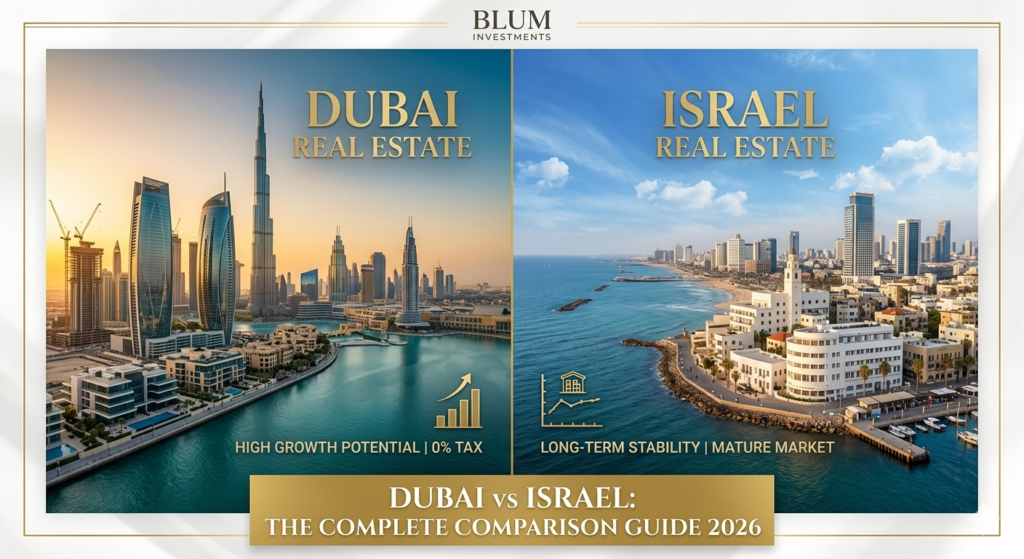
Expert Summary: In 2026, Dubai and Israel represent two fundamentally different real estate investment strategies. Dubai offers aggressive capital growth potential (8–18% annually in select off-plan neighborhoods) with zero taxation on rental income and capital gains, plus flexible developer payment plans requiring as little as 20% upfront. Israel offers long-term stability and inelastic demand in a mature market, but with significantly higher barriers: purchase tax of 8–10% for foreign investors (vs. 0% in Dubai), a minimum 50% equity requirement for mortgages, and average rental yields of 2–4% compared to Dubai’s 6–8% in prime communities.
For international investors particularly those in the Jewish diaspora communities of North America and Europe Dubai and Israel increasingly appear on the same shortlist. Both are dynamic Middle Eastern economies with strong real estate sectors, yet they could not be more different in their investment proposition.
This comparison exists because no comprehensive, data-driven analysis has been published that places these two markets side by side. Most content focuses on one market in isolation, leaving investors to piece together fragmented information. This guide fills that gap with concrete data, direct comparisons, and strategic guidance drawn from deep market research in both jurisdictions.
The fundamental question is not which market is “better” it is which market aligns with your investment objectives, risk appetite, and time horizon. Let the data guide the answer.
Dubai’s real estate market in Q1 2026 is defined by momentum. The off-plan segment accounts for 64% of all transactions, with an average price per square foot of AED 2,149 a 29% premium over ready properties. The overall median price has risen 14% year-on-year. The market is propelled by developer-led mega-projects, infrastructure investment (Metro Blue Line, Dubai Creek Tower), and a regulatory environment explicitly designed to attract foreign capital.
Key neighborhoods driving performance include Palm Jebel Ali (8–12% growth forecast), Dubai Creek Harbour (6–8% yields), and Nad Al Sheba Gardens (15–18% appreciation by mid-2026). The market rewards early, informed positioning in high-potential developments.
Israel’s real estate market operates on a fundamentally different logic. Demand is structurally inelastic driven by population growth, limited land availability, and deep emotional/cultural connections for diaspora investors. Prices have risen consistently over the past two decades, making it one of the most stable real estate markets globally.
However, the market presents significant barriers for foreign investors. Unlike Dubai’s investor-friendly framework, Israel’s system involves complex taxation, restrictive mortgage terms, and a bureaucratic purchase process conducted primarily in Hebrew. The investor experience in Israel is less about “where to find the best deal” and more about “how to navigate the system correctly.
Taxation is the single most impactful factor distinguishing these two markets. The gap is stark and often decisive.
| Tax Category | Dubai (UAE) | Israel (Foreign Investors) |
|---|---|---|
| Purchase Tax / Transfer Fee | 4% DLD registration fee (typically split 50/50 buyer-seller) | 8% on first ~ILS 5.87M; 10% above — no exemptions for foreigners |
| Rental Income Tax | 0% | Taxable at progressive rates (up to 50%); or flat 10% on gross with no deductions |
| Capital Gains Tax | 0% | 25% on real capital gains at sale |
| Annual Property Tax | Service charges only (varies by community) | Arnona (municipal tax): ILS 3,000–15,000/year |
| VAT | N/A on residential property | 17% VAT on new properties from developer |
Consider a $1 million property purchase:
For a yield-focused investor, the zero-tax environment in Dubai means that 100% of rental income flows directly to the bottom line. In Israel, after purchase tax, income tax, and eventual capital gains tax, the effective return is substantially reduced.
| Financing Factor | Dubai | Israel |
|---|---|---|
| Primary Financing Model | Developer payment plans (construction-linked) | Bank mortgage |
| Minimum Upfront Capital | 20% (80/20 plans available) | 50% minimum equity required |
| Bank Mortgage for Foreigners | Available (up to 50-75% LTV for non-residents) | Available (max 50% LTV for non-residents) |
| Foreign Currency Loans | Available (USD, EUR) | Available (USD, EUR, GBP) — unique advantage |
| Physical Presence Required | No (many transactions completed remotely) | Yes — most banks require in-person mortgage signing |
| Documentation Complexity | Moderate | High (translated foreign documents, Israeli tax ID required) |
Dubai’s developer payment plans are a powerful capital efficiency tool. With an 80/20 plan, an investor can control a $1 million off-plan asset with just $200,000 upfront, deploying the remaining capital over the 2–3 year construction period. During this time, the property may appreciate 20–30%, generating returns on capital far exceeding what a fully deployed investment would achieve.
In Israel, the same $1 million property requires $500,000 in equity plus approximately $100,000 in taxes and fees a total capital commitment of $600,000 before the first tenant moves in. The remaining $500,000 mortgage comes with strict terms and requires a complex, in-person application process.
This difference in capital efficiency is profound: the same $600,000 deployed in Dubai could control $3 million in off-plan assets, dramatically amplifying exposure to market appreciation.
| Market / Location | Gross Rental Yield (2026) |
|---|---|
| Dubai – Dubai Creek Harbour | 6–8% |
| Dubai – Nad Al Sheba Gardens | 5.5–7% |
| Dubai – Downtown Dubai | 5–5.5% |
| Israel – Tel Aviv prime areas | 2–3% |
| Israel – Jerusalem | 2.5–3.5% |
| Israel – Peripheral cities | 4–5% |
When adjusted for taxation, the gap widens further. Dubai’s net yield equals gross yield (0% tax), while Israel’s net yield after income tax can drop below 2% in prime areas.
| Market | 2026 Capital Growth Forecast | Growth Driver |
|---|---|---|
| Dubai – Palm Jebel Ali | 8–12% | Early-stage mega-project, 60% discount to Palm Jumeirah |
| Dubai – Nad Al Sheba Gardens | 15–18% | Proven demand, executive housing, phased supply |
| Dubai – Dubai Creek Harbour | 10–15% | Creek Tower, Metro Blue Line (20% uplift projected) |
| Israel – National average | 3–6% | Supply constraints, population growth |
| Israel – Tel Aviv premium | 4–7% | Tech sector demand, limited supply |
Dubai’s off-plan market offers 2–5x the annual capital growth compared to Israel’s established market. However, Israel’s growth, while more modest, is backed by decades of consistent upward momentum and structurally constrained supply offering lower volatility and higher predictability.
| Factor | Dubai | Israel |
|---|---|---|
| Transaction Speed | Days to weeks | 3–6 months |
| Language | English (primary business language) | Hebrew (all legal documents); English support available |
| Legal Representation | Recommended but not mandatory | Essential — complex legal system, Hebrew contracts |
| Remote Purchase Possible | Yes (largely digital) | Partially — mortgage signing typically requires presence |
| Regulatory Environment | Investor-friendly, designed for foreign buyers | Complex, higher barriers for non-residents |
| Property Registration | Dubai Land Department (digital, efficient) | Tabu (Land Registry) — can take months to process |
| Land Ownership | Freehold in designated areas (most investment zones) | ~93% state-owned land under long-term lease (49–98 years) |
Dubai’s purchase process is engineered for speed and simplicity. An international investor can identify, negotiate, and secure an off-plan property within days, with digital systems handling much of the paperwork. Israel’s process, by contrast, is methodical and paper-intensive, requiring specialized legal counsel, translated documents, and often physical presence for key milestones.
| Dimension | Dubai | Israel | Advantage |
|---|---|---|---|
| Capital growth potential | 8–18% (off-plan neighborhoods) | 3–7% (market average) | Dubai |
| Rental yield (gross) | 5.5–8% | 2–4% | Dubai |
| Taxation on purchase | ~2% (buyer’s share of DLD fee) | 8–10% (no exemptions) | Dubai |
| Income & capital gains tax | 0% | 10–50% income; 25% capital gains | Dubai |
| Minimum upfront capital | 20% (with payment plans) | 50% + 10% taxes/fees | Dubai |
| Market stability & predictability | Moderate (cyclical history) | High (20+ years of growth) | Israel |
| Ease of purchase process | High (digital, English, fast) | Low (Hebrew, complex, in-person) | Dubai |
| Residency benefits | Golden Visa (10-year, AED 2M+) | No automatic residency (Aliyah option for Jewish investors) | Dubai |
| Emotional / cultural value | Lifestyle / prestige | Deep personal / Zionist connection | Context-dependent |
| Long-term capital preservation | Moderate (dependent on market cycles) | High (structural demand) | Israel |
Yes. Following the Abraham Accords, Israeli citizens can freely purchase property in Dubai. The process is identical to any other foreign investor there are no restrictions based on nationality. Many Israeli investors have been active in the Dubai market since 2020, attracted by zero taxation, high yields, and the strengthening economic ties between the UAE and Israel.
Dubai by a significant margin. Gross rental yields in prime Dubai neighborhoods range from 5.5–8% (Dubai Creek Harbour leads at 6–8%), compared to 2–4% in Israel’s prime areas. When factoring in Dubai’s 0% tax on rental income versus Israel’s taxable rental income, the gap in net yield becomes even more pronounced.
On a $1M property: Dubai’s total acquisition cost is approximately $20,000 (2% DLD fee). Israel’s purchase tax alone is approximately $80,000 (8%) — 4x higher at acquisition. Over the investment lifecycle, Israel also levies income tax on rent and 25% capital gains tax at sale, while Dubai levies zero on both. The cumulative tax differential over a 10-year hold can exceed 20% of the property’s value.
Dubai carries higher short-term volatility risk, particularly in the off-plan segment where execution timelines and market cycles can impact returns. Israel carries lower volatility but higher entry barrier risk (high taxes, restricted financing) and liquidity risk (slower transaction process). Neither market is inherently “riskier” they present different risk profiles suited to different investor strategies.
Dubai: Yes a property investment of AED 2 million+ qualifies for a 10-year Golden Visa for the investor and family. Israel: Property ownership does not grant residency. However, Jewish investors can pursue Aliyah (immigration under the Law of Return) independently of property ownership, which grants full citizenship and residency rights.
The choice between Dubai and Israel is not binary it is strategic. Both markets offer genuine value for the right investor with the right objectives. What matters is aligning your capital with the market that best serves your financial goals, risk tolerance, and personal values.
Blum Investments is uniquely positioned to advise on both markets. As a firm with deep expertise across Dubai’s off-plan sector and Israel’s foreign investor landscape, we provide the holistic, cross-market intelligence that no single-market advisor can offer.
Whether you are drawn to Dubai’s aggressive growth and tax efficiency, Israel’s stability and cultural significance, or a diversified approach across both our team delivers the data, the strategy, and the execution to make it happen.