

📊 Expert Summary – Blum Investments
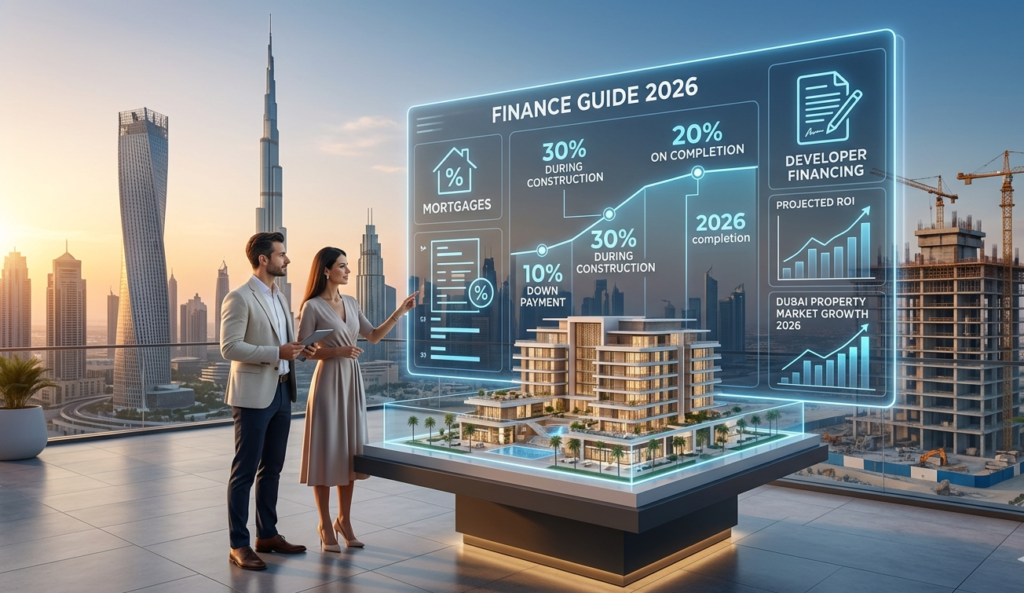
Financing off-plan property in Dubai in 2026 offers international investors exceptional flexibility compared to most global markets. Developer payment plans the most common financing method require only 20% upfront with the balance paid across construction milestones (80/20 plans) or upon handover. Bank mortgages are available to foreign investors at up to 50% LTV (loan-to-value), with interest rates ranging from 4.5%-6.5% depending on the lender. When combined with Dubai’s 0% income tax and 0% capital gains tax, leveraged returns on off-plan investments in top neighborhoods like Dubai Creek Harbour (projected 6-8% rental yield) and Palm Jebel Ali (8-12% capital appreciation) can exceed 25-40% annualized ROI on invested capital.
Why Off-Plan Financing in Dubai Is Different
Dubai’s off-plan real estate market operates on a fundamentally different financing model than what most international investors are accustomed to. Unlike markets in the US, UK, or Europe where purchasing property almost always involves a bank mortgage from day one Dubai’s off-plan market is primarily driven by developer-led payment plans that require no bank involvement during the construction phase.
This distinction is critical. In Dubai’s off-plan segment, which accounted for approximately 64% of all real estate transactions as of Q1 2026, the developer essentially acts as your lender during construction. You pay in installments tied to construction milestones, and the full balance is due upon or shortly after handover. Only at that point do most investors consider traditional bank mortgages if at all.
This system creates several unique advantages for international investors:
- Lower barrier to entry: Start with as little as 20% of the property value
- No interest during construction: Developer installments are interest-free
- Capital efficiency: Deploy capital gradually while the asset appreciates
- Flexibility: Option to sell (flip) before handover without ever needing a mortgage
- Tax efficiency: Combined with Dubai’s 0% income tax and 0% capital gains tax, financing costs are the only drag on returns
With off-plan prices averaging AED 2,149 per sq ft a 29% premium over ready properties and year-on-year price growth of 14%, understanding your financing options isn’t just helpful; it’s essential to maximizing your investment returns.
Developer Payment Plans Explained: 60/40, 70/30 & 80/20
Developer payment plans are the backbone of off-plan investment in Dubai. These plans structure your payments across the construction period and handover, eliminating the need for bank financing during the build phase. Here’s a detailed breakdown of the three most common structures:
80/20 Payment Plan (Most Investor-Friendly)
The 80/20 plan is the most favorable structure for investors seeking maximum capital efficiency. You pay 20% during construction and 80% upon or after handover.
Typical Structure (Example: AED 2,000,000 property):
- Booking deposit: 10% (AED 200,000) – at reservation
- During construction: 10% (AED 200,000) – spread across 2–4 milestones
- On handover: 80% (AED 1,600,000) – payable upon completion
Where it’s used: Palm Jebel Ali (Nakheel), select Emaar projects, Dubai South developments
Best for: Investors planning to flip before handover or arrange mortgage financing upon completion
70/30 Payment Plan (Balanced Approach)
The 70/30 plan requires 30% during construction and 70% at handover. This is common among premium developers who want to attract committed buyers while maintaining project financing flexibility.
Typical Structure (Example: AED 2,000,000 property):
- Booking deposit: 10% (AED 200,000)
- During construction: 20% (AED 400,000) – spread across 3–6 milestones
- On handover: 70% (AED 1,400,000)
Where it’s used: Select Emaar Creek Harbour phases, mid-tier developers
Best for: Investors who want more equity in the property before handover while still minimizing upfront capital
60/40 Payment Plan (Developer-Preferred)
The 60/40 plan requires 40% during construction and 60% at handover. This structure is favored by premium developers like Meraas for high-demand projects where inventory sells out quickly.
Typical Structure (Example: AED 2,000,000 property):
- Booking deposit: 10-20% (AED 200,000-400,000)
- During construction: 20-30% (AED 400,000-600,000)
- On handover: 60% (AED 1,200,000)
Where it’s used: Nad Al Sheba Gardens (Meraas), ultra-luxury developments
Best for: Serious buyers in high-demand projects; lower handover balance means less financing needed at completion
Post Handover Payment Plans
Some developers offer post-handover plans that extend payments 2/5 years beyond completion. These are particularly valuable because they allow investors to generate rental income while still paying off the property effectively letting the asset pay for itself.
Payment Plan Comparison at a Glance
| Feature | 80/20 | 70/30 | 60/40 |
|---|---|---|---|
| Capital during construction | 20% | 30% | 40% |
| Balance at handover | 80% | 70% | 60% |
| Interest-free period | ✅ Yes | ✅ Yes | ✅ Yes |
| Capital efficiency | ⭐⭐⭐ | ⭐⭐ | ⭐ |
| Flip potential | ⭐⭐⭐ | ⭐⭐ | ⭐ |
Mortgage Options for Foreign Investors
While developer payment plans cover the construction phase, many investors choose to finance the handover balance through a UAE bank mortgage. Here’s what foreign investors need to know about qualifying for and securing a mortgage in Dubai:
Key Mortgage Parameters for Non Residents
| Maximum LTV (Loan-to-Value) | 50% for non residents (vs. 75-80% for UAE residents) |
| Minimum property value | AED 1,000,000 (most banks) |
| Interest rates (2026) | 4.5%–6.5% (variable); 5.0%–7.0% (fixed 3–5 years) |
| Loan tenure | Up to 25 years |
| Minimum income | AED 15,000–25,000/month (varies by bank) |
| Age requirement | 21–65 years (loan must be repaid by age 65–70) |
| Currencies accepted | AED, USD, EUR, GBP (select banks) |
Required Documentation
Foreign investors typically need to provide:
- Valid passport with 6+ months validity
- Proof of income (salary certificates, tax returns, or audited accounts for business owners)
- Bank statements (6/12 months)
- Credit report from home country
- Property valuation report (arranged by the bank)
- Sales and Purchase Agreement (SPA)
- Down payment proof of funds
Pro tip: Banks assess affordability based on a Debt Burden Ratio (DBR) of 50%, meaning your total monthly debt obligations (including the new mortgage) cannot exceed 50% of your gross monthly income. This applies to debts in both the UAE and your home country.
Bank-by-Bank Comparison: Rates, LTV & Requirements
Not all UAE banks offer the same terms for non-resident investors. Here’s a comparative overview of the major lenders active in Dubai’s off-plan mortgage market as of Q1 2026:
| Bank | Max LTV | Variable Rate | Fixed Rate (3yr) | Min. Property | Standout Feature |
|---|---|---|---|---|---|
| Emirates NBD | 50% | 4.75% | 5.49% | AED 1M | Fastest processing |
| Mashreq Bank | 50% | 4.50% | 5.25% | AED 1M | Most competitive rates |
| HSBC UAE | 50% | 4.99% | 5.75% | AED 1.5M | Global banking integration |
| Abu Dhabi Islamic Bank | 50% | 5.25% | 5.99% | AED 1M | Sharia-compliant financing |
| Dubai Islamic Bank | 50% | 5.10% | 5.85% | AED 1M | Sharia-compliant; flexible terms |
| FAB (First Abu Dhabi) | 50% | 4.85% | 5.50% | AED 1M | Largest UAE bank; wide product range |
Note: Rates are indicative as of Q1 2026 and subject to change. Sharia-compliant financing (Ijara/Murabaha) operates on a profit-rate basis rather than interest, but the effective cost is comparable. Always obtain personalized quotes from multiple lenders.
ROI Calculations: Leveraged vs. Cash Purchases
Understanding the power of leverage in Dubai’s tax-free environment is where the real investment strategy lies. Let’s compare two scenarios using a Dubai Creek Harbour apartment—the neighborhood with the strongest projected rental yields of 6–8%:
📊 ROI Comparison: Cash vs. Leveraged Purchase
Property: 1-bed apartment, Dubai Creek Harbour | Price: AED 1,800,000
| Metric | Scenario A: Cash | Scenario B: 50% Mortgage |
|---|---|---|
| Purchase price | AED 1,800,000 | AED 1,800,000 |
| Equity invested | AED 1,800,000 | AED 900,000 |
| Mortgage (50% LTV at 5%) | — | AED 900,000 |
| Annual rental income (7% yield) | AED 126,000 | AED 126,000 |
| Annual mortgage cost (P&I, 25yr) | — | AED 63,100 |
| Service charges & maintenance (~AED 15/sqft) | AED 12,000 | AED 12,000 |
| Net rental income | AED 114,000 | AED 50,900 |
| Cash-on-Cash Return (rental) | 6.3% | 5.7% |
| Capital appreciation (est. 10%/yr) | AED 180,000 | AED 180,000 |
| Total Return on Equity | AED 294,000 | AED 230,900 |
| Annualized ROI on Invested Capital | 16.3% | 25.7% |
Key insight: While the cash buyer earns more in absolute terms, the leveraged investor achieves a 25.7% return on invested capital vs. 16.3%—a 58% improvement in capital efficiency. This is especially significant when considering that Dubai imposes 0% tax on rental income and capital gains, meaning every dirham of return flows directly to the investor.
Off-Plan Leverage: The Construction Phase Advantage
The real power of off-plan financing emerges during the construction phase. Consider a Palm Jebel Ali villa on an 80/20 plan:
- Purchase price: AED 6,000,000
- Capital deployed (20%): AED 1,200,000
- Projected appreciation (10% over 2 years): AED 1,200,000
- ROI on deployed capital: 100% over 2 years (50% annualized)
If the investor sells (flips) before handover, they never need to finance the remaining 80%. The AED 1.2M gain is earned on just AED 1.2M invested 100% return, tax-free.
Hidden Costs & Fees Every Investor Must Know
Accurate ROI projections require accounting for all transaction and holding costs. Here’s a comprehensive breakdown:
Transaction Costs (One-Time)
| Fee | Amount | Notes |
|---|---|---|
| DLD Registration Fee | 4% of purchase price | Paid to Dubai Land Department; non-negotiable |
| DLD Admin Fee | AED 580 | Fixed administrative charge |
| Agent Commission | 2% of purchase price | Standard; may be negotiable for high-value deals |
| Oqood Fee (off-plan) | 4% of purchase price | Initial registration of off-plan property; converted to title deed at handover |
| Mortgage Registration Fee | 0.25% of loan amount | Only if using bank mortgage |
| Bank Processing Fee | 1% of loan amount | Some banks offer to waive or reduce this |
Annual Holding Costs
- Service charges: AED 12/25 per sq ft (varies by community and developer)
- Property management: 5/8% of annual rental income (if using a management company)
- Insurance: AED 1,000/3,000 per year
- DEWA deposits: AED 2,000/4,000 (refundable)
- Income tax: 0% (Dubai)
- Capital gains tax: 0% (Dubai)
Smart Financing Strategies for 2026
Based on our analysis of the current market conditions and the top investment neighborhoods, here are the strategies Blum Investments recommends for maximizing returns through smart financing:
Strategy 1: The “Flip Before Handover” Play
Best for: Capital-efficient investors targeting rapid appreciation
Purchase an off-plan unit on an 80/20 plan in a high-growth area like Palm Jebel Ali. With only 20% invested and projected 8–12% annual appreciation, aim to sell your position before the handover payment is due. This avoids the need for mortgage financing entirely and can generate annualized returns exceeding 40% on invested capital.
Strategy 2: The “Yield + Growth” Hold
Best for: Long-term investors seeking income and appreciation
Purchase in Dubai Creek Harbour using a developer payment plan during construction, then secure a 50% LTV mortgage at handover. With projected rental yields of 6–8% and 20% capital uplift from infrastructure catalysts (Creek Tower + Metro), you benefit from both cash flow and growth. The rental income covers mortgage payments with positive cash flow from year one.
Strategy 3: The “Golden Visa Portfolio”
Best for: Investors seeking residency + returns
Invest AED 2 million+ to qualify for the UAE Golden Visa (10-year residency). Combine a Nad Al Sheba Gardens villa (proven 15–18% appreciation) with residency benefits for yourself and your family. The Golden Visa also opens doors to UAE banking relationships, which can improve future financing terms.
Strategy 4: The “Multi-Unit Diversification”
Best for: Portfolio investors with AED 3–5M+ capital
Instead of purchasing one large unit, spread capital across 2–3 smaller units in different neighborhoods. For example: one apartment in Dubai Creek Harbour (yield focus) and one in Palm Jebel Ali (growth focus). Developer payment plans allow this diversification with relatively modest upfront capital.
Frequently Asked Questions
Can I get a mortgage for an off plan property before it’s completed?
Generally, no. UAE banks issue mortgages upon handover (completion), not during construction. During the build phase, your financing comes from the developer’s payment plan. However, some banks offer “pre-approval” during construction, guaranteeing your mortgage terms for handover. This is worth pursuing early ideally 6–12 months before expected completion.What happens if I can’t pay the handover balance?
If you cannot fund the handover payment, you have several options: (1) secure a bank mortgage to cover the balance, (2) negotiate a post-handover payment plan with the developer, or (3) sell your off-plan unit on the secondary market before handover. The third option is common and can be very profitable if the property has appreciated. Failing to pay can result in contract termination and forfeiture of paid installments, so planning ahead is critical.Is Islamic (Sharia-compliant) financing available for foreign investors?
Yes. Several UAE banks—including Dubai Islamic Bank and Abu Dhabi Islamic Bank offer Sharia compliant financing to non-resident investors. These products use Ijara (lease-to-own) or Murabaha (cost-plus financing) structures instead of interest-based loans. The effective cost is comparable to conventional mortgages, and LTV limits (50% for non-residents) remain the same.Can I finance a Dubai property using equity from my home country?
Yes, this is a common strategy. You can use a home equity loan or line of credit in your home country to fund the down payment or construction installments for a Dubai off-plan property. Since Dubai developer payment plans are interest-free, using lower-rate home equity financing to fund installments can be highly capital-efficient. Consult with a cross-border financial advisor to optimize the tax implications.What is the 4% DLD fee and can it be avoided?
The 4% Dubai Land Department (DLD) registration fee is mandatory and applies to all property purchases. It cannot be avoided or negotiated. However, some developers offer promotions where they cover 50% or 100% of the DLD fee particularly during launch phases. Additionally, for off-plan purchases, the 4% Oqood (initial registration) fee is separate from the final DLD title deed fee. Confirm with your developer and agent which fees are included in the purchase price.How long does the mortgage approval process take for a non-resident?
For non resident investors, the mortgage approval process typically takes 2/4 weeks from application to final offer, assuming all documentation is in order. The property valuation (ordered by the bank) usually takes 5/7 business days. Total timeline from application to fund disbursement is approximately 4/6 weeks. Starting the process early especially obtaining pre-approval gives you negotiating leverage and ensures a smooth handover.
🏆 Ready to Structure Your Dubai Investment?
Blum Investments provides end-to-end support for international investors—from identifying the right property and payment plan to connecting you with preferred banking partners for optimal mortgage terms. Our team has facilitated hundreds of off-plan transactions across Dubai’s premium neighborhoods.
Blum Investments | Your Partner in Global Real Estate
This article is for informational purposes only and does not constitute financial or investment advice. All investments carry risk. Market data is based on Q1 2026 research. Mortgage rates and terms are indicative and subject to change. Consult with a qualified financial advisor before making investment decisions. Sources: DXB Analytics, RERA, Bayut, Property Finder, individual bank rate sheets.